DesireCore v10.0.196
Release Date: 2026-11-02
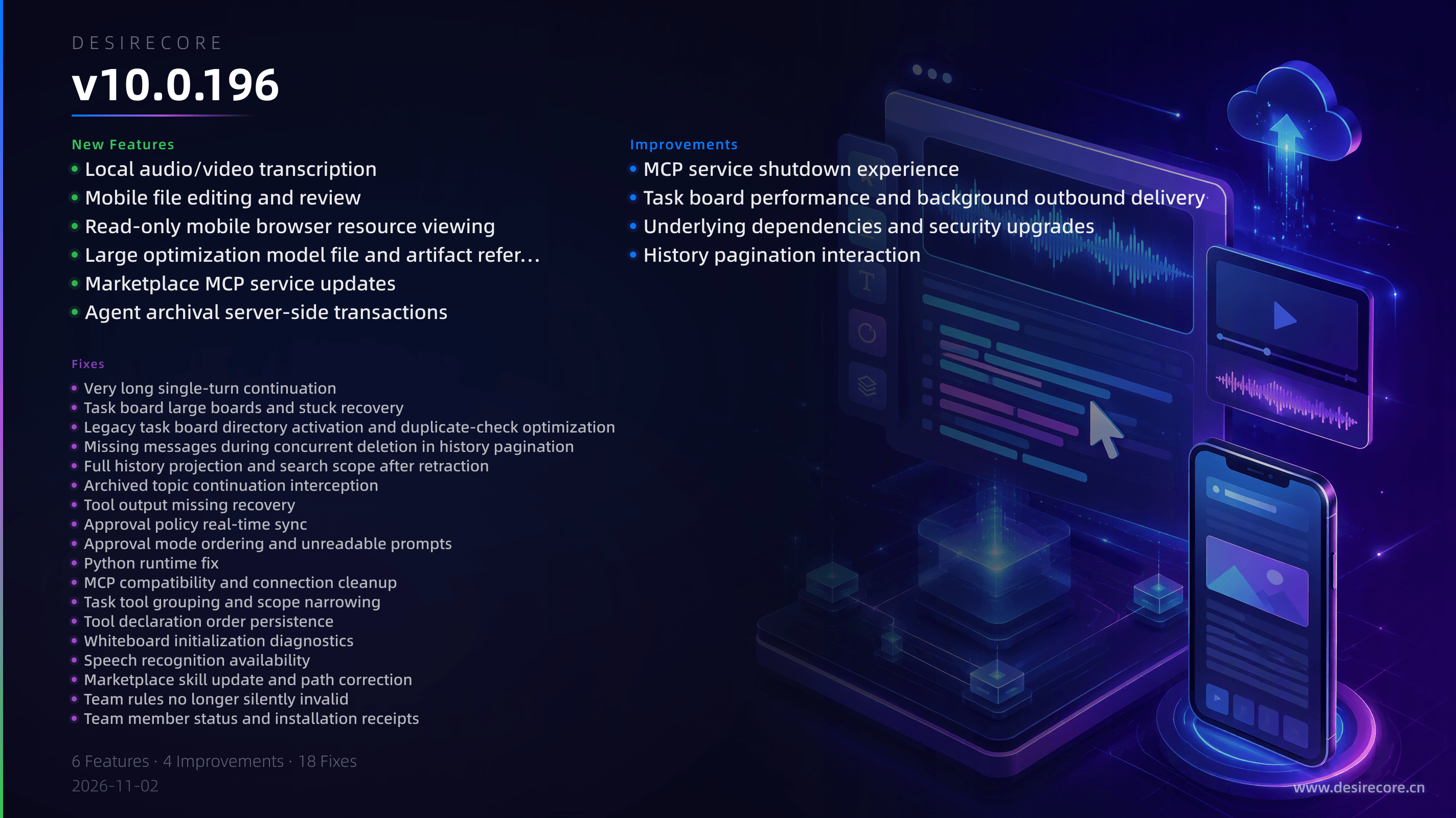
New Features
- Local audio/video transcription: Added a built-in audio transcription tool. Agents can convert local audio or video into timestamped text and use the configured recognition service; configured recognition destinations are passed through directly and disclosed in the results.
- Mobile file editing and review: On mobile, you can now securely edit workspace text, view diffs, and roll back, with authorization and traceable receipts for each action.
- Read-only mobile browser resource viewing: Authenticated users can browse browser resource directories and JPEG viewport screenshots in read-only mode on mobile. Management keys and leases are not sent to the phone.
- Large optimization model file and artifact references: Optimization compilation, artifact publishing, and associated tools now support passing large-scale model data through file and artifact references, so large models can be compiled and solved without generating parameters verbatim.
- Marketplace MCP service updates: Installed marketplace MCP services show reviewed new versions. Upgrades preserve environment variables, working directory, disabled status, and protocol preferences, and roll back to the previous configuration on failure.
- Agent archival server-side transactions: Added Agent archive, restore, permanent delete, list, and detail endpoints in preparation for changing deletion to archival later. The current UI and deletion entry points still perform hard deletes.
Fixes
- Very long single-turn continuation: Long single-turn subtasks larger than 16 MiB can now resume from the merged actual content. When recovery is not possible, the system explains missing closing records, corrupted lines, or interrupted writes instead of incorrectly reporting “empty history.”
- Task board large boards and stuck recovery: The task board single-commit read limit is raised to 16 MiB, and a clear error is returned when the limit is exceeded. Interrupted writes are automatically finalized before reading, so task creation and task board viewing no longer fail as a whole.
- Legacy task board directory activation and duplicate-check optimization: After legacy installations finish backfilling history indexes, notifications and relationship outbound delivery are automatically activated. Board duplicate checks read only the first commit, avoiding long blocking during startup recovery and task creation.
- Missing messages during concurrent deletion in history pagination: When paging upward through normal history encounters concurrent deletion or retraction, surviving messages are no longer skipped. If recovery fails, the current window and position are retained and retried after an explicit upward action.
- Full history projection and search scope after retraction: After a manual topic retraction fails, the full history projection and recovery entry are retained. Pure deletion no longer changes conversation activity time, and surviving results within the same search scope do not disappear.
- Archived topic continuation interception: Archived or deleted manual topics are rejected before the model is called and return a clear reason, instead of reusing existing runs to write messages.
- Tool output missing recovery: After a tool completes, if the model output or source state projection is missing, it is recovered from a fully identical complete copy within the same run. When local cloud sync is not ready, it is no longer misreported as an upstream API error.
- Approval policy real-time sync: When the approval policy directory appears only after the initial read, the system automatically adds a watch. Externally modified policy files are reflected in the UI in real time instead of continuing to show stale tiers.
- Approval mode ordering and unreadable prompts: Approval modes are now sorted by server epoch and revision number, so old state does not overwrite new state across multiple windows, external modifications, or reconnects. When a policy file cannot be parsed, the UI explains the reason and provides a repair entry point.
- Python runtime fix: Python source records left by first-launch offline import are automatically rewritten to the correct address, so Python installation, deletion, and display no longer fail.
- MCP compatibility and connection cleanup: MCP configuration now tolerates future additional fields instead of failing whole-configuration validation. Connection tests, health probes, and shutdown flows have explicit timeouts and error codes, and clean up the full child process tree.
- Task tool grouping and scope narrowing: Task creation, updates, and comments are now loaded and retained as a group, preventing junk tasks from being mistakenly created repeatedly in long conversations. Agents also no longer see task actions that only humans can perform.
- Tool declaration order persistence: Tool recent-use and failure-closed records are persisted with the session. After rebuilding, eviction follows recent use, preventing a just-used tool from being evicted too early.
- Whiteboard initialization diagnostics: Whiteboard creation, checking, and takeover failures now provide the specific reason, location, and next step. The full schema can be obtained through the tool catalog before creation.
- Speech recognition availability: Fixed unselectable speech recognition presets and added available recognition models. Automatic language is no longer fixed to Chinese recognition; the server now auto-detects the language.
- Marketplace skill update and path correction: When a single-skill pointer source moves forward, it now correctly prompts that an update is available and retrieves the new content. Built-in runtime skill path notes are updated, so Agents no longer use the system package manager to reinstall already built-in Node or Python.
- Team rules no longer silently invalid: After a distribution seed upgrade, team rules that are actually introduced by the new seed are automatically renewed. Other unapproved changes go to the notification center instead of silently not being injected.
- Team member status and installation receipts: Team settings no longer misreport locally existing members as missing. Truly missing members are given a path based on whether they can be filled, need resolution, or have no source. Team installation no longer fails when a member requires a higher client version.
Improvements
- MCP service shutdown experience: External MCP stdio child processes are now spawned and reclaimed by the platform itself. On shutdown or restart, wrapper-started services are terminated along the process tree, reducing leftovers.
- Task board performance and background outbound delivery: After legacy inventory backfills directories, activation is on demand. Boards with no new commits are skipped by fingerprint, and V4/V5 policy board history events are backfilled only once, noticeably reducing idle CPU.
- Underlying dependencies and security upgrades: Upgraded base dependencies including desktop runtime, chart rendering, and model inference, and fixed several HTTP parsing and rendering security issues. Unsupported offline portrait cutout on x64 Macs now directly indicates the reason.
- History pagination interaction: Pagination retry adds a keyboard entry point and preserves scroll position. Late receipts from old sources or from before clearing are isolated, preventing jumps to the bottom or mixing windows.