DesireCore v10.0.164
Release Date: 2026-09-16
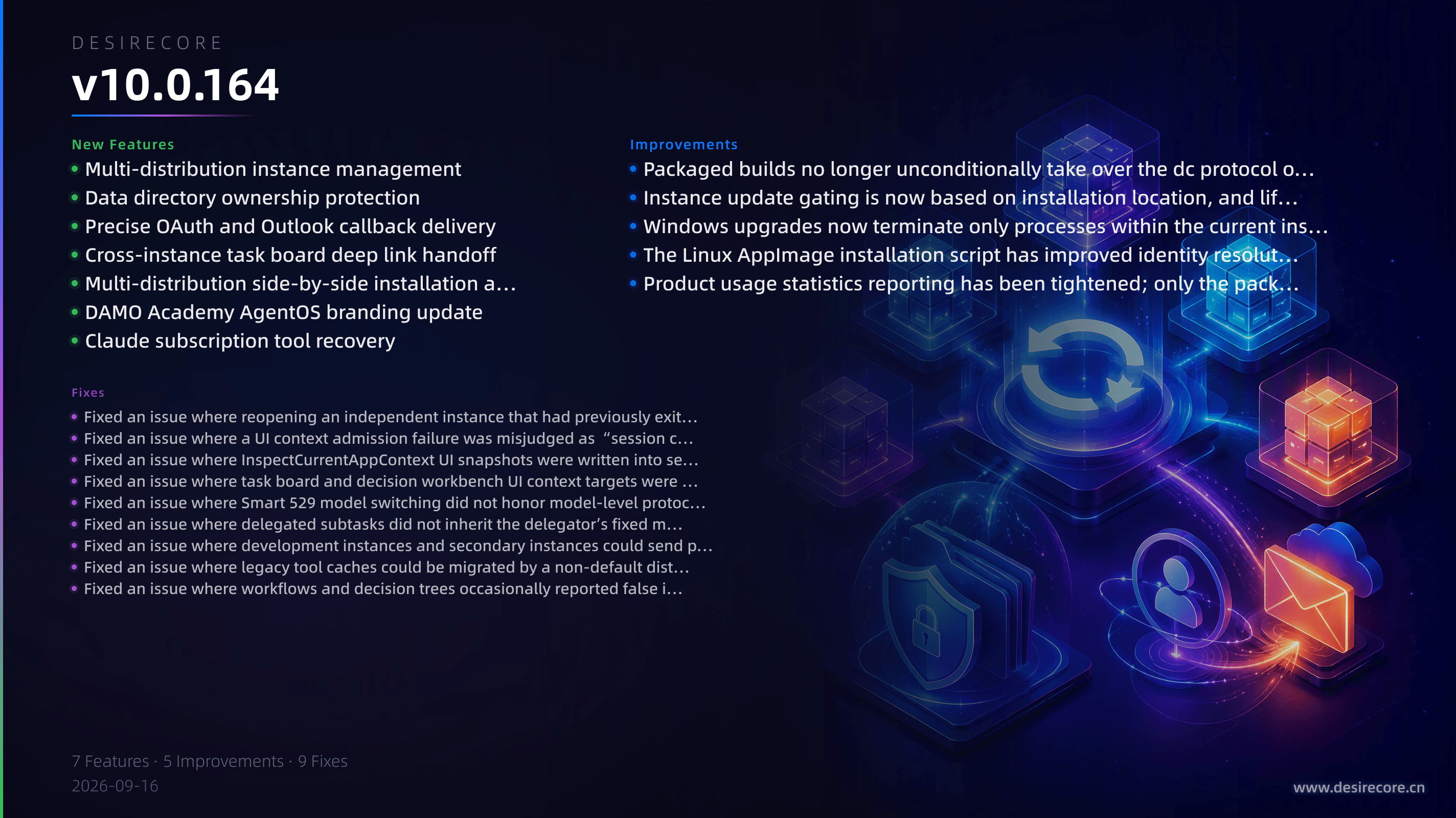
New Features
- Multi-distribution instance management: The instance picker now displays all local DesireCore / DAMO Academy AgentOS instances grouped by distribution, supports viewing running status, opening, switching to an already running window, and removing instances, and launches the corresponding version of the application based on the distribution each instance belongs to.
- Data directory ownership protection: Each data directory can only be opened by its owning distribution. If opened by another distribution by mistake, the app enters a fallback page or asks for confirmation to take over, preventing cross-distribution data writes.
- Precise OAuth and Outlook callback delivery: When multiple instances are running at the same time, browser authorization callbacks are delivered only to the instance that initiated authorization instead of being broadcast to every instance. Cold-start processes used only for routing callbacks do not open the main window.
- Cross-instance task board deep link handoff: When multiple instances using the same protocol exist on the machine, task board links include an instance identifier and open directly to the instance that owns the task. If the target is not running, it is automatically launched according to its owning distribution.
- Multi-distribution side-by-side installation and upgrade isolation: The Windows installer, upgrade flow, and Linux AppImage installation script all work according to distribution identity. Different distributions can be installed side by side, upgraded, and uninstalled independently, and upgrades do not mistakenly terminate processes of other distributions or overwrite protocols.
- DAMO Academy AgentOS branding update: The former “DAMO Academy Solver Agent” has been renamed to “DAMO Academy AgentOS,” and executable and installer package names have been updated accordingly.
- Claude subscription tool recovery: When a Claude model directly calls an undeclared tool, it no longer fails the entire turn and incurs repeated billing. Instead, it returns the result as “tool does not exist,” allowing the model to discover the tool on its own and continue.
Fixes
- Fixed an issue where reopening an independent instance that had previously exited abnormally from the instance picker would always fail the first time and require opening it again.
- Fixed an issue where a UI context admission failure was misjudged as “session clearing in progress,” causing message submission to stall and require manual confirmation.
- Fixed an issue where InspectCurrentAppContext UI snapshots were written into session history, which could cause a restored model to incorrectly judge that the UI contained secrets.
- Fixed an issue where task board and decision workbench UI context targets were rebuilt too frequently, causing snapshots read by the model to expire quickly and backend objects to grow without bound.
- Fixed an issue where Smart 529 model switching did not honor model-level protocol overrides, and where switching models in a direct connection session could send old credentials to a modified endpoint.
- Fixed an issue where delegated subtasks did not inherit the delegator’s fixed model, and installed team members that needed updates were skipped.
- Fixed an issue where development instances and secondary instances could send product usage statistics to production endpoints.
- Fixed an issue where legacy tool caches could be migrated by a non-default distribution or non-owner instance and overwrite the production data root.
- Fixed an issue where workflows and decision trees occasionally reported false integrity errors and crashed child processes during concurrent publishing or atomic writes.
Improvements
- Packaged builds no longer unconditionally take over the dc protocol on every launch. They now take it over only when there is no handler, the handler is invalid, unregistered, too old, or its location has changed, avoiding contention among multiple instances.
- Instance update gating is now based on installation location, and lifecycle locks are partitioned by distribution. Starting, updating, and shutting down instances of different distributions no longer block each other.
- Windows upgrades now terminate only processes within the current installation directory, and the downloaded installer package is checked against the current distribution before upgrading to prevent installing the wrong version.
- The Linux AppImage installation script has improved identity resolution, legacy runtime fallback, invalid handler detection, and error messages, making installation more robust.
- Product usage statistics reporting has been tightened; only the packaged default instance reports by default, while development instances and secondary instances do not report by default.