DesireCore v10.0.116
Release Date: 2026-08-23
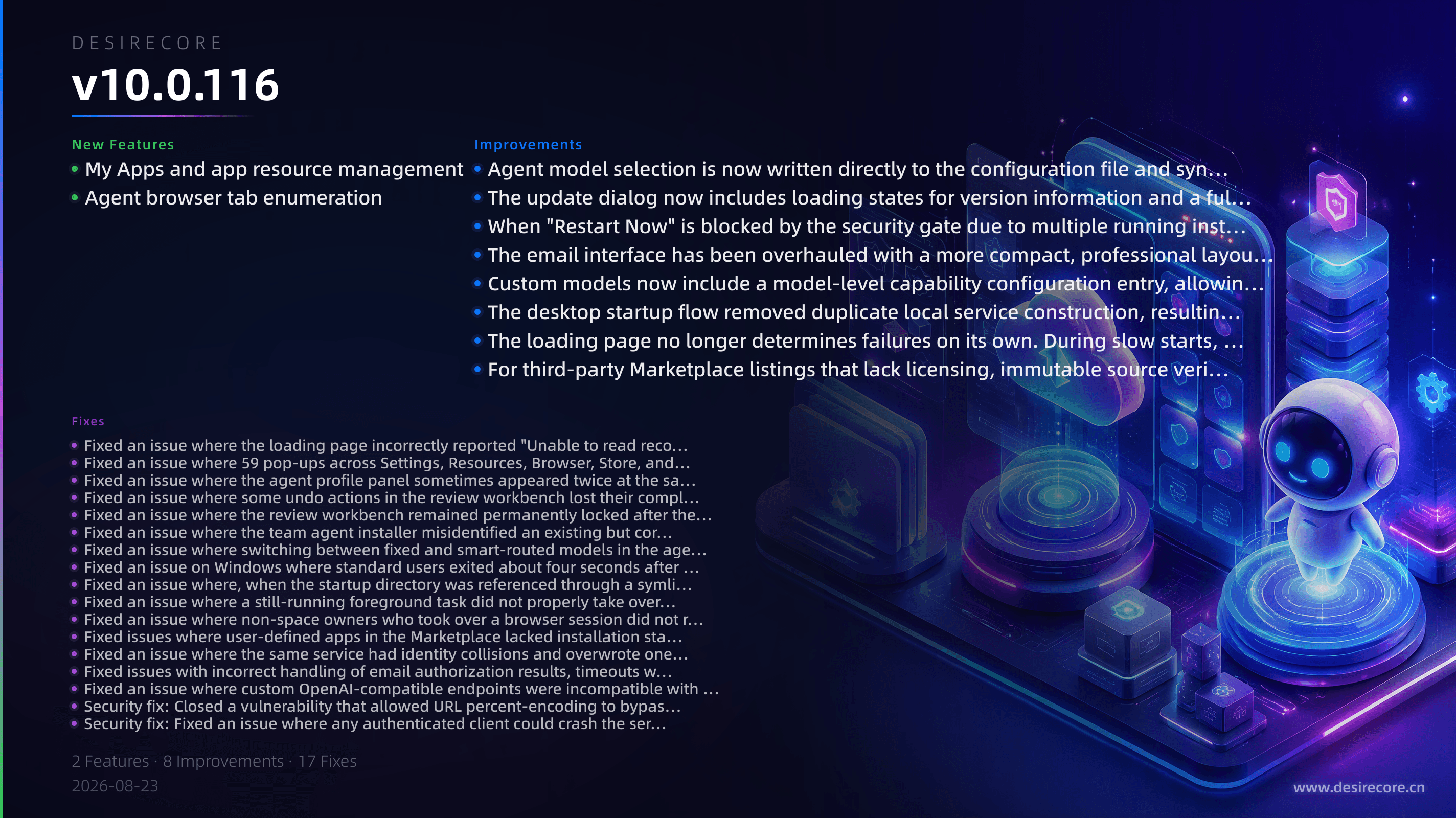
New Features
- My Apps and app resource management: Added a new "My Apps" area for centrally viewing and launching installed apps. Apps run in an isolated embedded view with restricted downloads, pop-ups, and script execution. The Resources panel also adds entries for app and service management, and the Marketplace can now discover agents, skills, apps, and services in one place.
- Agent browser tab enumeration: The built-in desktop browser now supports a tab list command, allowing agents to list all tabs in a session in scenarios that previously failed, such as with multiple tabs or no active tab. The list is filtered by the current authorization scope and does not show out-of-scope tabs.
Fixes
- Fixed an issue where the loading page incorrectly reported "Unable to read recovery state" on first launch of the stable version, and the connection recovery page was entirely non-functional in release packages. When a connection failure occurs, users can now enter a usable recovery interface.
- Fixed an issue where 59 pop-ups across Settings, Resources, Browser, Store, and other areas were half-covered by the embedded browser view.
- Fixed an issue where the agent profile panel sometimes appeared twice at the same time, with one instance pinned to the upper-left corner of the window and impossible to close.
- Fixed an issue where some undo actions in the review workbench lost their completion status and statistics after refresh or restart, preventing further operation.
- Fixed an issue where the review workbench remained permanently locked after the source task ended and required a page refresh to continue undoing, including scenarios where the server had stabilized but the local UI still showed it as running, and where listeners did not recover after operation prechecks.
- Fixed an issue where the team agent installer misidentified an existing but corrupted agent directory, including its memory and workspace, as leftover data and deleted it entirely.
- Fixed an issue where switching between fixed and smart-routed models in the agent settings interface did not actually take effect.
- Fixed an issue on Windows where standard users exited about four seconds after launch because directory permission checks required elevated privileges.
- Fixed an issue where, when the startup directory was referenced through a symlink, the instance control plane silently degraded and logs falsely reported "Companion port failed to start."
- Fixed an issue where a still-running foreground task did not properly take over the session after disconnection and reconnection, causing history refresh, usage reload, streaming placeholders, and retry/edit actions to all point to the old task.
- Fixed an issue where non-space owners who took over a browser session did not receive browser events or screenshot streams and could not see the state of the session they were controlling.
- Fixed issues where user-defined apps in the Marketplace lacked installation status, causing the details page to crash; the resource list did not refresh after service approval or rejection; agent-associated apps lacked an unbind entry point; and some back/close buttons lacked accessible names.
- Fixed an issue where the same service had identity collisions and overwrote one another under different providers. Marketplace agent installation and uninstallation are now precisely bound to one-time human authorization.
- Fixed issues with incorrect handling of email authorization results, timeouts when re-authorizing existing accounts, and no feedback for authorization failures from some providers. Also removed misleading buttons that had no actual effect.
- Fixed an issue where custom OpenAI-compatible endpoints were incompatible with the developer role and the minimum reasoning effort parameter.
- Security fix: Closed a vulnerability that allowed URL percent-encoding to bypass the human approval governance gate, enabling agents to be created or deleted, or model configuration to be modified, without approval.
- Security fix: Fixed an issue where any authenticated client could crash the service process by sending a specific error event.
Improvements
- Agent model selection is now written directly to the configuration file and synchronized across directory cloning, importing, and exporting. Old fixed bindings and allowlists are automatically migrated during upgrades, and switching back and forth between fixed and smart routing no longer loses the selected scope.
- The update dialog now includes loading states for version information and a full skeleton screen. The version list and current version are fetched in parallel, with a minimum display duration to avoid flicker, and stale requests no longer overwrite the latest state.
- When "Restart Now" is blocked by the security gate due to multiple running instances or a standalone instance window, the reason is now clearly shown instead of silently doing nothing.
- The email interface has been overhauled with a more compact, professional layout for accounts, lists, conversations, and the detail reading area. Sync status is now a space-saving floating tooltip, and hovering over lists no longer causes virtual row jitter.
- Custom models now include a model-level capability configuration entry, allowing default values to be set for parameters such as reasoning effort.
- The desktop startup flow removed duplicate local service construction, resulting in faster cold starts and lower transient memory usage.
- The loading page no longer determines failures on its own. During slow starts, neutral loading messages are now displayed in stages over time. A red alert is shown only when the main process explicitly reports a failure, and internal terminology has been removed from the loading copy.
- For third-party Marketplace listings that lack licensing, immutable source verification, branding, or audit evidence, the default is now to display them only and not allow one-click installation.