DesireCore v10.0.83
Release Date: 2026-07-12
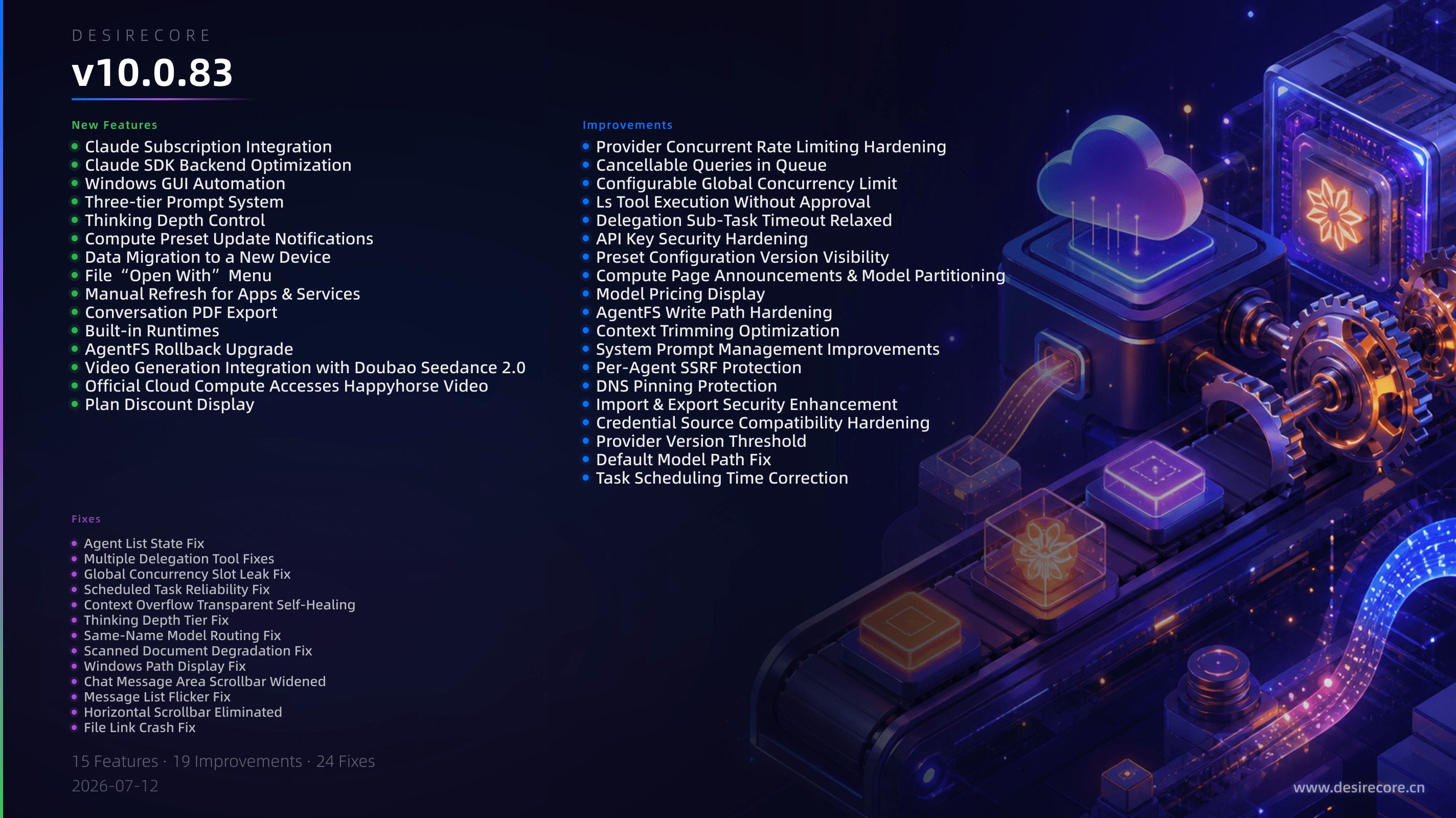
New Features
- Claude Subscription Integration: Claude Pro/Max subscriptions can now be used as a compute source. Connect via Claude Code login, in-app OAuth, or a manual token. Model calls are fulfilled through the official Agent SDK.
- Claude SDK Backend Optimization: Conversation history automatically resumes a cached Claude session to reduce duplicate quota consumption. Images can be passed directly to the model. WebSearch is available during conversations.
- Windows GUI Automation: The Windows client includes a built-in cua-driver. Agents can directly operate native application interfaces (screenshot, click, input) with zero installation and out‑of‑the‑box use.
- Three‑tier Prompt System: A new global tier (user‑level) and team‑tier prompts are added, applied together with the Agent tier. The Prompt Center manages all three tiers with structured editing and live preview.
- Thinking Depth Control: A thinking depth selector (Auto/Off/five depth levels) has been added to the input area. Supports three‑level priority: session, Agent, and global default, and works with OpenAI, Anthropic, and domestic model dialects.
- Compute Preset Update Notifications: User‑customized Provider configurations are no longer silently overwritten by upstream updates. When conflicts arise, review them item by item in the review panel and adopt upstream values with a single click.
- Data Migration to a New Device: The export wizard can package agents, configurations, and API keys (encrypted) for migration to a new device. During import, the system automatically identifies and completes identity replacement or data merging.
- File “Open With” Menu: File entries in chats now have an “Open With” dropdown to let you open the file inside the app, with the system default, with another program, or locate it in the folder.
- Manual Refresh for Apps & Services: A refresh button has been added to the page title bar so you can manually sync the service directory status.
- Conversation PDF Export: Export now uses client‑side rendering, making the process more stable.
- Built‑in Runtimes: Python 3.13 and Node.js 24 LTS are bundled with the installer, silently imported on first launch, and fully available offline.
- AgentFS Rollback Upgrade: Agent file system rollback now uses Git full‑tree snapshots, supporting complete restoration. Git is built into the application so there are no system dependencies.
- Video Generation Integration with Doubao Seedance 2.0: The video generation pipeline now adapts to the Doubao Seedance model, supporting start/end frames and multiple reference images.
- Official Cloud Compute Accesses Happyhorse Video: Official cloud compute users can now use happyhorse-1.1 video generation and OpenAI image generation directly.
- Plan Discount Display: The purchase page can now show strikethrough original prices and discount information.
Fixes
- Agent List State Fix: Imported/cloned agents now appear online immediately without needing to restart the app. The chat sidebar correctly refreshes names after an agent is renamed.
- Multiple Delegation Tool Fixes: Parallel delegation no longer skips target validation; invalid targets produce clear errors. Delegation cards correctly display multiple target names. AgentFS file watching resumes immediately and takes effect on change.
- Global Concurrency Slot Leak Fix: Stopping generation no longer causes a session to be permanently stuck in “Queued”. Concurrency slots are no longer exhausted after the system wakes from sleep.
- Scheduled Task Reliability Fix: Scheduled tasks now truly execute the full workflow when due, instead of being truncated after one reply. Failed tasks back off and retry correctly instead of retrying endlessly. One‑time tasks are prevented from firing more than once.
- Context Overflow Transparent Self‑Healing: When the cloud model’s actual context window differs from what is declared, the system learns the real limit from error messages and auto‑adjusts. Large output is now produced in a single pass instead of being split into continuations.
- Thinking Depth Tier Fix: The deepest tier’s budget no longer collapses; the distinction between tiers is back to normal. Resetting to the default tier no longer leaves a previous depth setting active.
- Same‑Name Model Routing Fix: When an official cloud model and a local Provider share the same name, requests are now precisely routed to the intended Provider without leaking to another.
- Scanned Document Degradation Fix: Non‑vision models reading pure scanned documents now prompt to switch models directly without getting stuck in infinite repetitive output.
- Windows Path Display Fix: Windows paths in system prompts no longer lose backslashes and stay correct after copying.
- Chat Message Area Scrollbar Widened: Makes mouse dragging easier.
- Message List Flicker Fix: Scrolling further when already at the bottom no longer causes the whole window to flicker.
- Horizontal Scrollbar Eliminated: Long URLs now wrap, and wide tables scroll internally, so content remains fully visible.
- File Link Crash Fix: Clicking a local file link in an Agent reply no longer crashes the window; the file is opened by the system’s default application instead.
- Task Board Startup Noise Elimination: Startup and session switching no longer generate 404 error logs.
- Market Repository Source Save Fix: Adding a repository source no longer gets stuck at “Saving” or shows duplicates.
- Service Directory Real‑time Status Update: The directory now refreshes automatically after a service is registered; no manual action is needed.
- Relationship Graph Delivery Edge Fix: The relationship edge for successful Agent delivery is now correctly displayed.
- Input Cursor Following: After actions like line breaks or history navigation, the cursor now auto‑scrolls into the visible area.
- Message Action Bar Overflow Fix: Action buttons on short messages no longer cover the timestamp.
- Multi‑select Mode Fix: Clicking the selection circle in multi‑select mode now responds reliably and is no longer intercepted by video players or other elements.
- Relationship Heat Display Optimization: Heat values are now shown with a thousands separator and one decimal place, no longer overflowing the card.
- Windows Data Clear Fix: In‑app data clearing no longer fails because of read‑only Git files or reserved device name files.
- macOS Build Fix: Fixed packaging failures caused by notarization rejections and broken symbolic links.
- Large File Publishing Fix: Large installer uploads now use chunked uploads, eliminating timeouts and freezes on slow links.
Improvements
- Provider Concurrent Rate Limiting Hardening: You can now configure the maximum concurrent requests per Provider and a queuing strategy to avoid upstream throttling. A real‑time diagnostic endpoint is also provided.
- Cancellable Queries in Queue: Queries waiting in the queue can now be properly cancelled. Interactive queries are prioritized over background tasks.
- Configurable Global Concurrency Limit: The top‑level concurrent query limit defaults to 3 and can be adjusted via an environment variable.
- Ls Tool Execution Without Approval: Listing directory contents no longer requires approval; permission checks are delegated to the operating system. Clear authorization guidance is provided when accessing restricted directories.
- Delegation Sub‑Task Timeout Relaxed: The synchronous wait timeout has been extended from 5 minutes to 30 minutes. After a timeout, the sub‑task is no longer automatically terminated; the caller decides whether to continue or stop.
- API Key Security Hardening: Agents can only write keys and cannot read them. Keys are masked by default in the UI. File tools precisely intercept attempts to read key files.
- Preset Configuration Version Visibility: The current preset data version number is displayed at the top of the Compute page, making it easier to troubleshoot configuration sync issues.
- Compute Page Announcements & Model Partitioning: Official cloud models are now displayed in partitions for Text, Image Generation, and Video Generation. Generation‑only models are marked “Unavailable in conversations”.
- Model Pricing Display: Token‑priced models show a relative rate multiplier. Other billing modes show the unit price and pricing basis. Vendor information is displayed at the top.
- AgentFS Write Path Hardening: Concurrent modification of Agent configurations no longer loses updates. Crashes during a write no longer leave half‑written files.
- Context Trimming Optimization: The trimming budget is more precise. When results of re‑fetchable tools are evicted, re‑fetch guidance is preserved. Auto‑compression and memory injection ensure delivery to the model.
- System Prompt Management Improvements: Agent‑level capability declaration toggles are now supported. Persona editing uses a structured form. Prompt preview shows the visual proportion of each section.
- Per‑Agent SSRF Protection: Each Agent can independently configure restrictions for external network access, preventing DNS rebinding attacks.
- DNS Pinning Protection: Before actually sending an outbound request, the Agent verifies the target IP again to prevent a domain from being tampered with to point to an internal network after registration.
- Import & Export Security Enhancement: Prevents malicious zip archive boundary over‑writes. The service automatically recovers after a failed import.
- Credential Source Compatibility Hardening: New credential source types no longer cause older clients to crash or make compute resources unavailable. Unsupported credential sources show a clear upgrade prompt.
- Provider Version Threshold: Upstream Provider presets can declare a minimum client version. If the requirement is not met, an upgrade prompt is shown instead of silently failing.
- Default Model Path Fix: Missing Provider identifiers in historical data are now auto‑repaired. Explicitly specified Providers are no longer incorrectly routed to other Providers.
- Task Scheduling Time Correction: The current time is now automatically injected at every turn of the conversation. The Agent no longer calculates based on the “old time” from when the session started.