DesireCore v10.0.98
Release Date: 2026-08-05
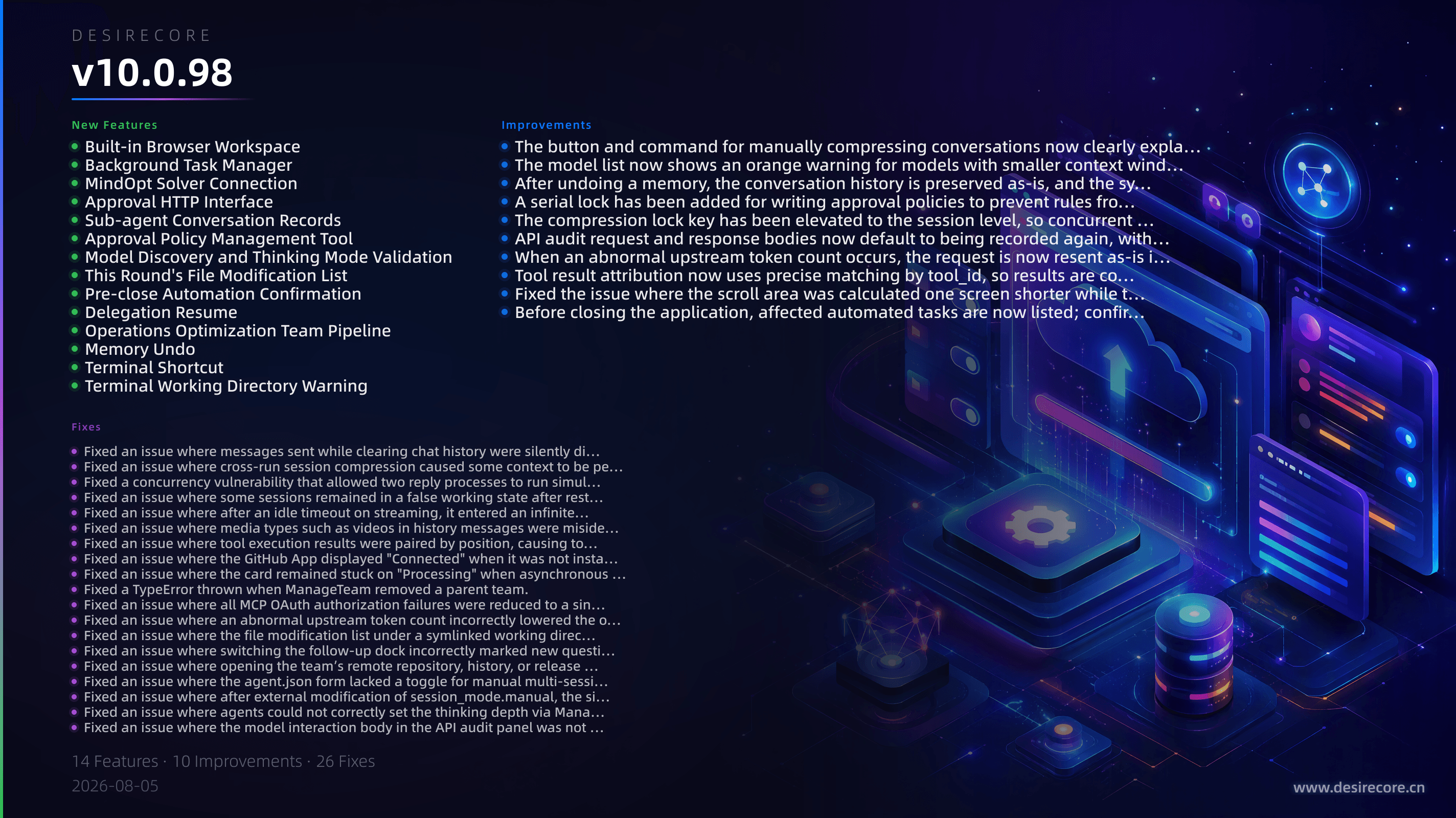
New Features
- Built-in browser workspace: A new governed built-in browser has been added, supporting concurrent isolated multi-agent sessions, cookie/storage import, mouse trajectory and drag visualization, network diagnostics, and strict permission and lease controls.
- Sub-agent conversation history viewable: The full conversation history of tasks delegated to other agents or temporary workers can now be viewed directly in a read-only overlay, without switching sessions.
- Failed delegated tasks can be resumed: Delegated tasks that failed can now be continued with their existing context and tool results, eliminating the need to re-delegate from scratch.
- One-click undo for memory cards: An undo button has been added to cards where the agent writes or updates memories, allowing precise one-click rollback (deleting newly created files or restoring previous content) and notifying the agent that the memory has been undone.
- Modified files list displayed each turn: A summary card of modified files (e.g., "Edited 3 files +20 −3") is automatically shown at the end of each conversation turn, with the option to send the resulting files of the turn to the user with a single click.
- Terminal panel shortcut: A new `Ctrl+`` shortcut (consistent with VS Code) has been added to quickly open or close the current agent's terminal panel.
- Terminal working directory mismatch warning: When the terminal's working directory differs from the current session's work tree (e.g., the agent switched Git work trees), a clear warning is displayed at the top of the terminal with a one-click sync option.
- Agent discovery of models and reasoning tiers: Agents can now view all available models and their supported reasoning depths; attempting to set an unsupported depth tier will be explicitly rejected with a list of valid options.
- Approval policy management tool: A new
ManageExecApprovalsbuilt-in tool enables agents to view and request changes to execution approval modes and rules (changes require user confirmation). - Approval feature supports mobile: A new HTTP approval interface allows mobile and other non-persistent-connection clients to fetch pending approvals and complete approvals.
- MindOpt solver connector: A new governed MindOpt operations research solver connector and standalone gateway deployment solution are added, supporting submission of mathematical optimization tasks via HTTPS.
- Confirmation for automated tasks before exit: When closing the application, a confirmation dialog appears if there are scheduled tasks, heartbeat self-checks, or active sessions, preventing accidental shutdown of automated services.
- Background task manager: A new independent global task manager shows resource usage and real-time output for all background tasks and system processes, and supports one-click stop or forced restart.
- Real-time agent busy status: When an agent is executing a task, the resource manager and the left-hand session list correctly display a "working" status and broadcast changes in real time.
- Session list avatar identification: Avatar badges clearly distinguish whether an agent is running locally or remotely, and provide status cues such as online, busy, and offline.
- Recoverable multi-agent optimization pipeline: Supports creating persistable operations research optimization pipelines (forecasting, compilation, solving, validation) that can be resumed from breakpoints after interruption, without re-invoking models.
Fixes
- Fixed an issue where stream idle timeout caused agents to enter an infinite silent retry loop, and optimized retry prompts during network anomalies.
- Fixed an issue where automatic cross-session turn compression caused context to be silently discarded, ensuring summary coverage strictly aligns with the discard scope.
- Fixed an issue where switching from a large-window model to a small-window model resulted in early conversations being permanently compressed and impossible to recover when switching back to a large model.
- Fixed an issue where multiple sessions could run concurrently on the same agent; user-visible sessions now strictly execute serially.
- Fixed issues where tool execution results were misattributed due to positional matching and file modification lists were lost in approval mode.
- Fixed an issue where messages sent during a "clear chat history" operation were silently discarded and unrecoverable.
- Fixed an issue where some agents remained stuck in a fake "working" state long after restarting the app, and the sidebar's last message preview did not update.
- Fixed an issue where videos in historical messages were incorrectly recognized as images, causing broken images, and some attachment-only messages containing tools were not rendered.
- Fixed an issue where panel buttons (e.g., remote repository, team history) opened from the chat "more" menu were unresponsive and the pop-over disappeared immediately.
- Fixed an issue where the interface incorrectly displayed "Connected" and verification success when the GitHub App was not installed or lacked repository write permissions.
- Fixed an issue where file modification lists degenerated into verbose absolute paths from the second turn onward when the working directory path contained symlinks.
- Fixed an issue where concurrent modification of approval policies could silently lose "always allow" rules.
- Fixed an issue where the
ManageTeamtool threw an error when passingnullto remove a parent team setting. - Fixed an issue where all MCP OAuth authorization failures were lumped into a single generic prompt, making it impossible to diagnose the specific cause.
- Fixed an issue where, when the upstream model gateway returned a context length error due to miscounting image tokens, the system erroneously reduced the output limit, causing truncated replies.
- Fixed an issue where the terminal panel's scroll area was miscalculated while hidden in the background, preventing scrolling to the latest output after switching back.
- Fixed an issue where cloned tools failed to load because traceability metadata fields were not declared in the schema.
- Fixed an issue where the chat sidebar did not follow real-time changes when manual multi-session mode was toggled externally.
- Fixed an issue where the delegation card remained permanently in "processing" state instead of showing "failed" when an asynchronous delegation failed.
- Fixed an issue where the body of model interactions was not recorded by default in API audit details, and added automatic cleanup and backup exclusion mechanisms to protect privacy.
- Fixed text overlapping and truncation in the Windows upgrade progress window under high DPI scaling.
- Fixed an issue where native component integrity manifests included files for non-target architectures, causing false verification failures during full Windows updates.
- Fixed a width collapse in the file workbench interface, resulting in a large blank area on the right and horizontal scrollbars in the code editor.
- Fixed an issue where images referenced across directories in Markdown previews could not be displayed when the agent registered multiple working directories.
- Fixed a race condition in the follow-up question input where switching to a different question could incorrectly mark an unread new question as "read".
- Fixed an issue where the multi-instance picker window could not be closed (added a close button).
Improvements
- The manual "Compress conversation" menu and command now clearly inform that this operation only affects the context window seen by the model; the complete original chat history remains unaffected and can be reviewed at any time.
- In the model selection list, a non-blocking orange warning badge is now displayed for models whose context window is smaller than the current session's usage.
- The
agent.jsonresource manager form has been comprehensively improved: titles and visual controls for previously missing fields such as manual multi-session mode, author, and avatar have been added. - Request and response body recording in API auditing is now enabled by default, with newly added automatic expiration cleanup and data export exclusion rules to safeguard privacy.
- Error messages for MCP OAuth authorization failures now include structured error codes and actionable fix suggestions, with strict sanitization of sensitive credentials.
- Network stream idle timeout thresholds now apply separately based on first-byte and inter-byte intervals, preventing false timeouts during the initial silent phase of long-thinking models.