DesireCore v10.0.163
Release Date: 2026-09-15
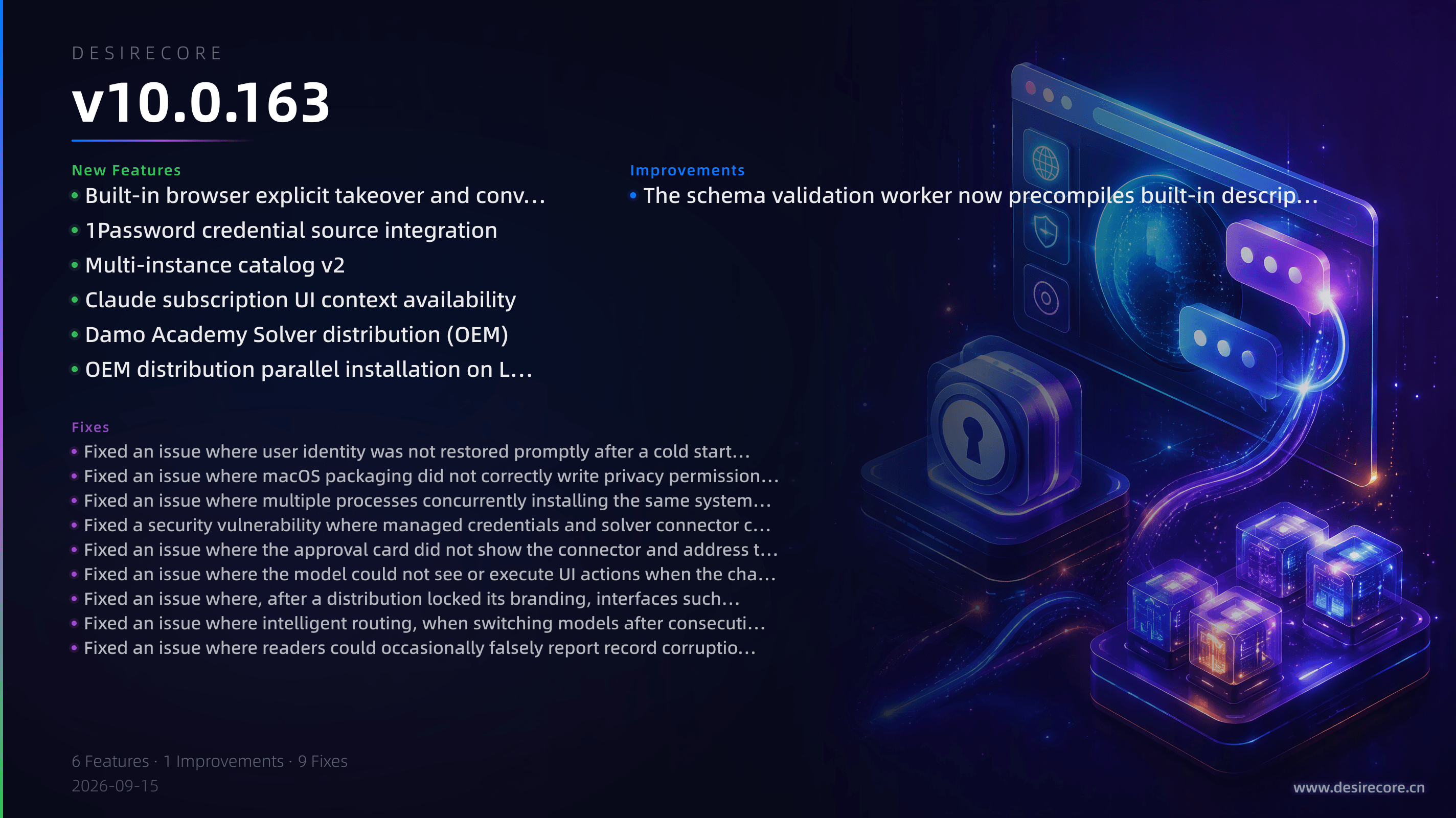
New Features
- DAMO Academy solver agent distribution: On first launch, automatically installs the built-in solver agent, team, solver connector configuration, and decision workspace, and supports side-by-side installation and operation with DesireCore.
- 1Password credential source integration: The account management page now supports connecting to, browsing, linking, and disconnecting 1Password sources; it also adds a desktop integration import channel that can search 1Password items and copy them into the built-in credential vault.
- Explicit browser user takeover and conversation resume: The built-in browser adds an "I'll take over" button for users to explicitly take over, removes the "Resume Agent" button, and after users finish operating they can simply say "you continue" in the conversation to let the Agent resume.
- Claude subscription UI context: Claude subscription users can enable visible UI context, allowing the Agent to view the current interface and perform UI actions.
- Multi-instance registry v2: Each instance has an authoritative record, making identification, deletion, and lifecycle management more reliable in multi-instance environments.
Fixes
- Fixed an issue where macOS privacy permission declarations (contacts, calendar, photos, location, etc.) were not written into the packaged Info.plist, causing macOS TCC to deny access to protected resources.
- Fixed an issue where the built-in browser failed to restore the user identity during cold start, resulting in a 403 when selecting a BrowserSpace owned by the user.
- Fixed an issue where enabling UI context caused access references to be dropped when sending from the input box, and UI actions were invisible or failed to execute when the chat page had history.
- Fixed a security vulnerability that allowed the Agent to reference solvers and managed credentials by name, and fixed a race condition where registration decisions could be missed when overwritten within the same time granularity.
- Fixed an issue where concurrent installation of system cache tools could produce corrupted binaries or installation failures.
- MindOptSolve approval summaries now state the connector and address to which credentials are sent.
- Fixed an issue where checkpoint timer leaks caused unnecessary idle spinning after a round ended.
- Fixed an issue where structure validation falsely reported timeouts under high CPU load.
- Fixed an issue where Smart routing, when switching models after consecutive 529 errors, incorrectly connected directly upstream through the proxied session, causing 401 errors.
- Fixed an issue where seed migration left empty directories in the source user scope after completion.
- Fixed an issue where normal race conditions during concurrent fork-for-resend publishing were misjudged as record corruption.
- Fixed an issue where, when branding was locked, the core agent still displayed DesireCore instead of the distribution name in conversations, history, search, notifications, and other UI surfaces.
- Fixed a Windows signing certificate issue and restored Windows installer package release (v10.0.162 was skipped due to signing failure).
- Fixed an issue where duplicate imports on development branches prevented
npm run devfrom starting.
Improvements
- The UI context pruning strategy now retains the action catalog and focused node, and splits visible revisions from action revisions to avoid the Agent's own output invalidating UI action snapshots.
- System cache tool installation now uses a per-process exclusive staging directory and atomic replacement, improving installation reliability during concurrent first launches.
- The data root is now split by distribution; non-default distributions use a separate data directory, paving the way for side-by-side installation and operation with DesireCore.
- The Claude subscription runtime now uses online profile table lookups, and internal requests are normalized and moved into the transport layer, improving subscription session stability.
- For non-default distributions, update checks, download filenames, and reporting are isolated by distribution, making the update process independent from DesireCore.