DesireCore v10.0.160
Release Date: 2026-09-13
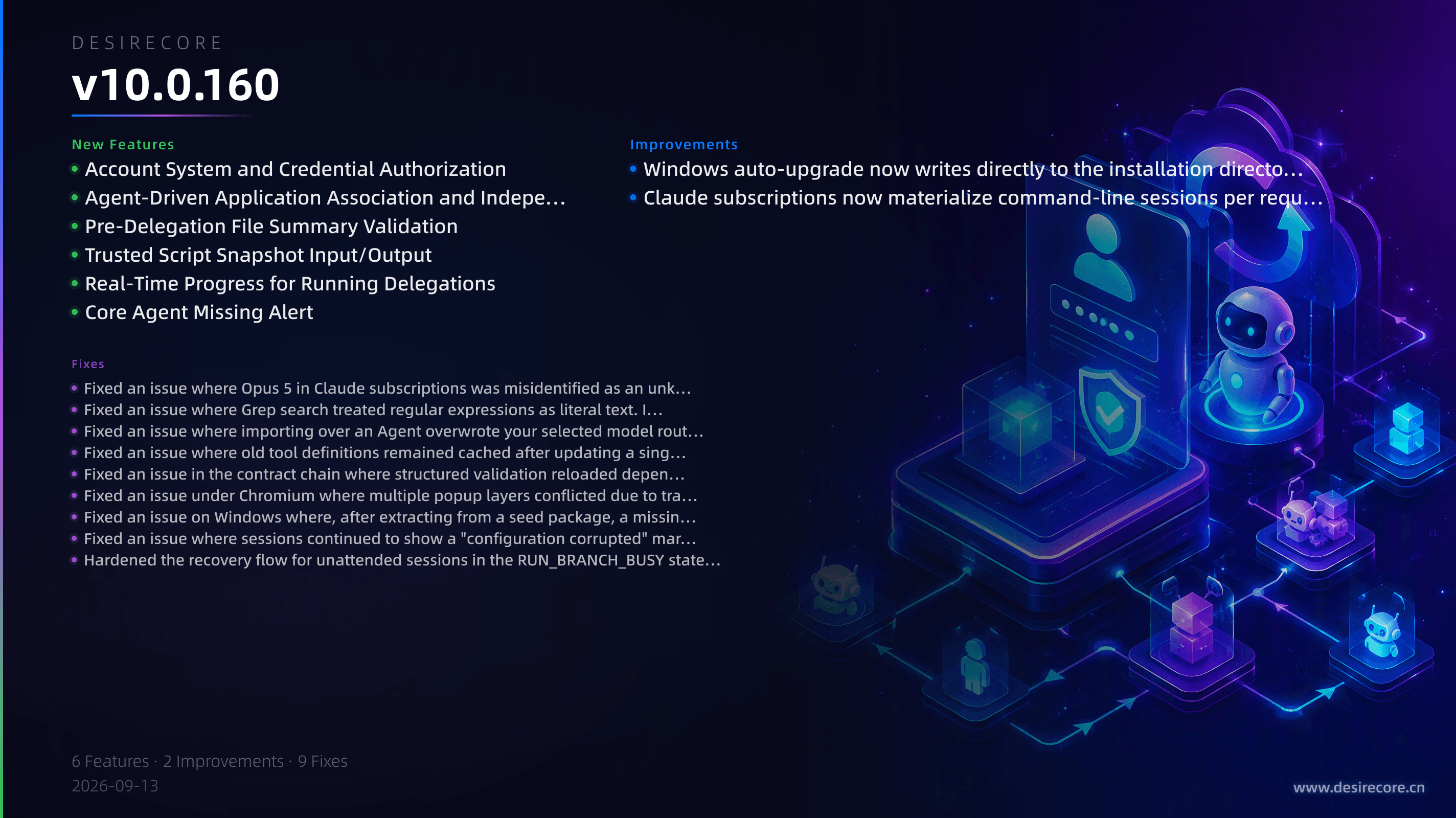
New Features
- Account System and Credential Authorization: Added an account resource view for centrally viewing and managing credential entries, with an "Allow/Ask every time/Deny" authorization policy for each entry. When an Agent reads protected credentials, it must first be authorized through an approval card. Supports batch authorization, delete confirmation, and default password masking.
- Agent-Driven Application Association and Independent Uninstall: Applications now serve as optional entry points for Agents and can be shared by multiple Agents. When an Agent is deleted, applications are kept by default and other users are prompted; only an explicit choice uninstalls them independently per entry. Uninstalling an application does not delete the Agent.
- Pre-Delegation File Summary Validation: Source agents can declare pre-delegation validation policies to validate the structure and quantity of file summaries before dispatch. Mismatches are rejected and a verifiable validation result is returned to the model. When no policy is declared, previous behavior is preserved.
- Trusted Script Snapshot Input/Output: The trusted script tool adds optional snapshot input/output configuration. Before execution, authorized files are read and recorded; after execution, only new results that pass hash verification are published, avoiding path traversal and preventing non-zero exits from being masked by success messages in run output.
- Real-Time Progress for Running Delegations: Ongoing delegation subtasks show a bounded real-time summary and tool count, and do not appear as completed before the subtask actually finishes, making it easier to distinguish running subtasks from stuck ones.
- Core Agent Missing Alert: When the system does not detect a core Agent, it shows a dismissible alert bar reminding you to check whether the core Agent is missing, while avoiding false alarms for a normal state with zero non-core Agents.
Fixes
- Fixed an issue where Opus 5 in Claude subscriptions was misidentified as an unknown model and errored under the automatic reasoning tier, and where the official Anthropic endpoint was needlessly retried on tool turns with skipped thinking, causing cache invalidation. Related conversations now follow adaptive thinking semantics correctly and generate fewer unnecessary requests.
- Fixed an issue where Grep search treated regular expressions as literal text. Instructions to the model now explicitly require marking regular expression searches, and search results better match expectations.
- Fixed an issue where importing over an Agent overwrote your selected model routing. Import overwrites now retain the original routing configuration and avoid incorrectly reporting missing configuration when the configuration is corrupted.
- Fixed an issue where old tool definitions remained cached after updating a single Agent, preventing the new tool structure from taking effect immediately. After an update, the relevant tool and skill caches are now refreshed automatically.
- Fixed an issue in the contract chain where structured validation reloaded dependencies on each run and could trigger the 5-second startup timeout. Validation workers are now reused, making validation responses faster and more stable.
- Fixed an issue under Chromium where multiple popup layers conflicted due to translucent backgrounds and overflow clipping, causing the last item to float outside the panel with no background. Dropdown menus such as approval mode now display completely and have a normal background.
- Fixed an issue on Windows where, after extracting from a seed package, a missing git index caused market sync to misjudge local divergence and archive the entire repository once. After extraction, the index is now rebuilt on demand, so the first sync is no longer misjudged.
- Fixed an issue where sessions continued to show a "configuration corrupted" marker after backend configuration recovery. Refresh now adopts the latest backend health status and automatically clears the old error marker after recovery.
- Hardened the recovery flow for unattended sessions in the RUN_BRANCH_BUSY state by adding blocking reasons and stable receipt credentials, so background task results can be reliably promoted even after restart, reducing stalls and loss.
Improvements
- Windows auto-upgrade now writes directly to the installation directory when the old directory has already been moved away, eliminating temporary extraction and copying and making upgrades significantly faster. If installation files are incomplete or the disk is full, it automatically rolls back and prompts for recovery when the old version starts; failures no longer silently leave a corrupted application.
- Claude subscriptions now materialize command-line sessions per request. Long idle periods, restarts, model switches, or context compaction no longer cause multi-turn conversation errors, making the continuation experience more stable.