AgentOS v10.0.185
Release Date: 2026-10-19
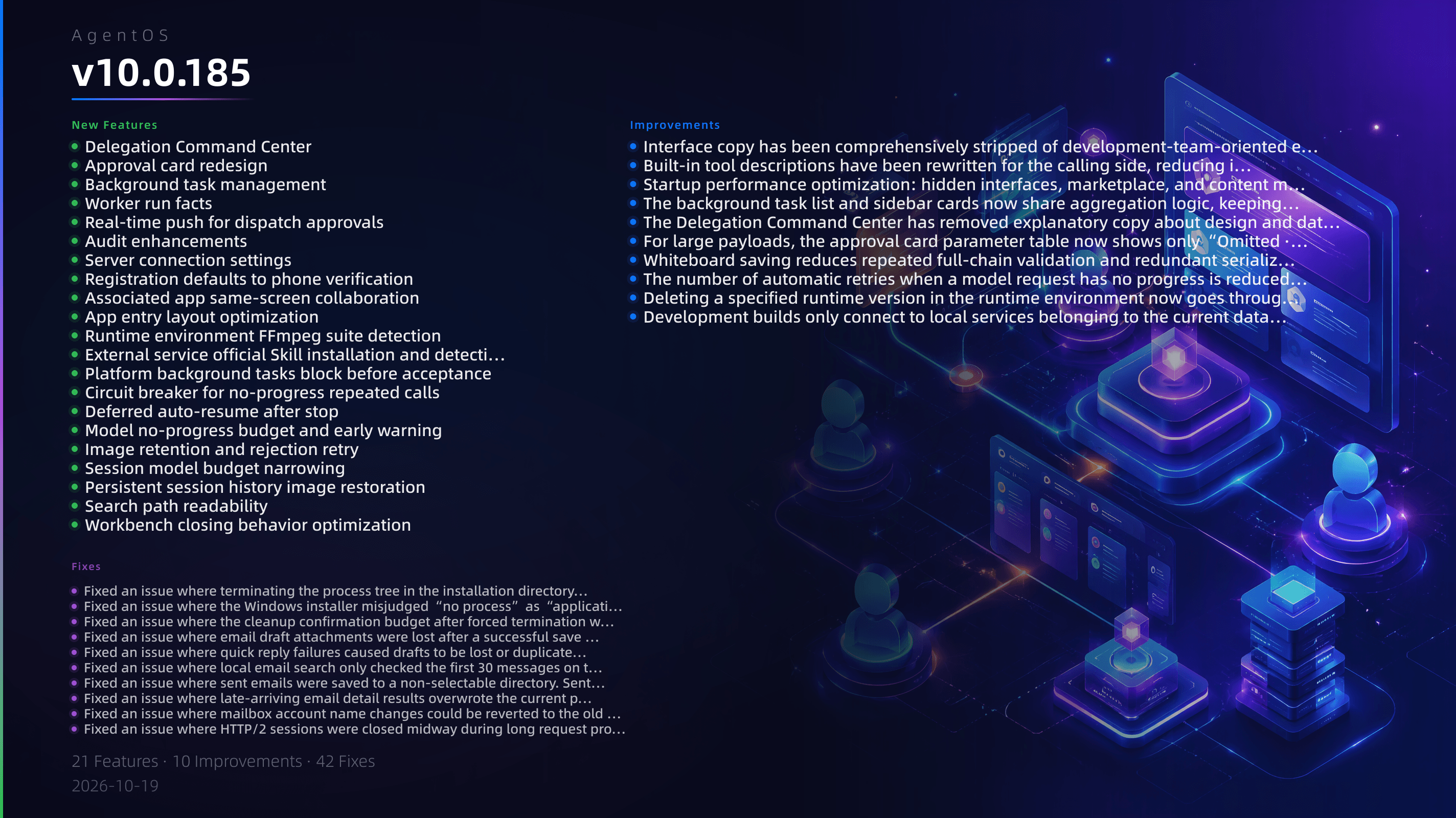
New Features
- Delegation Command Center: The default label on the task board has been changed to “Delegation Overview”, summarizing pending items from both task and project perspectives, sorted by “Awaiting your approval › Awaiting your acceptance › Execution finished but not submitted › Overdue › Execution failed › Automatic handling consecutive failures”, and supporting one-step new delegation and a manual acceptance decision panel.
- Approval card redesign: The approval card has been redesigned into a compact five-layer structure, with materials split by audience. Approval cards are associated with their corresponding tool calls, and receipts appear immediately after the tool row. Bash commands are classified by content and display risk labels. Tools such as editing notebooks, exiting worktrees, and running workflows provide structured evidence.
- Background task management: The background task list is grouped by “In progress by me / Initiated by me / Routine” and supports nested display. Background commands, Workers, outgoing delegations, and subtasks can be stopped directly inline. Workers moved to the background are now included in the run center.
- Worker run facts: Temporary Workers now have server-side run facts, and their display can be restored after a refresh or disconnection. After a Worker moved to the background ends naturally, is stopped, or recovers after a restart, terminal states such as completed, failed, or stopped are written back to the delegation card.
- Real-time push for dispatch approvals: Approvals generated during dispatch runs are delivered in real time to toasts, the notification center, and system notifications. Open the dispatch run popup to handle them directly, without polling or reconnecting.
- Audit enhancements: Audit details can now jump to the detailed record of the corresponding execution, and record per-request context token estimation breakdowns.
- Server connection settings: When login or connection fails, an entry to server connection settings is available. Before saving, the target service is validated for availability, and on failure the current configuration and account session are preserved.
- Registration defaults to phone verification: The registration entry now defaults to the phone number verification code page, and provides a clear email registration entry.
- Associated app same-screen collaboration: When opening an associated app from the agent sidebar, the chat and app can be arranged side by side or switched within the same workspace, preserving the source topic, draft, and trusted pages. The app appearance follows the host theme.
- App entry layout optimization: The associated app entry has been moved to the environment status floating widget at the top right of the message area. App authorization has been moved to the left navigation bar, freeing up content area height.
- Runtime environment FFmpeg suite detection: The runtime environment page can detect ffmpeg/ffprobe versions and paths, and list installed skills that depend on them.
- External service official Skill installation and detection: The marketplace now has entries for installing and checking connections for official Skills. It validates package contents before installation and checks local service and extension connection status after installation.
- Platform background tasks block before acceptance: When dependencies for platform background tasks are not ready, tasks are blocked before acceptance and the reason is shown in scheduling details, instead of running empty and being recorded as success without a reason.
- Circuit breaker for no-progress repeated calls: When the model consecutively calls the same tool with the same parameters and produces the same results, the system gives stepped prompts and finally finishes without tool calls, instead of idling indefinitely.
- Deferred auto-resume after stop: After the user stops generation, the session will not be immediately pulled into a new round by asynchronous reports. Reports are kept in the inbox and injected after the user speaks again.
- Model no-progress budget and early warning: When a request makes no new progress for a long time, streaming retry is triggered up to a configurable limit. The interface switches from “Deep thinking…” to “Waiting for model response · N minutes without new progress”, and recovers after real incremental output.
- Image retention and rejection retry: Consumed images are removed from model requests by turn and count, and per-request image count and size limits are set. When upstream rejects images, the original upstream text is written to the image position and that turn retries immediately, instead of failing the whole turn.
- Session model budget narrowing: The session context window and output limit now take the minimum among the specification, access item, and user override, avoiding sending requests that exceed what the access item declares.
- Persistent session history image restoration: When a persistent session is restored from a snapshot, historical user images are restored, and images pasted in the previous message are still carried in follow-up questions.
- Search path readability: During Glob/Grep searches, when reading existing but permission-denied directories or files, existing results are kept and the reason is explained, instead of returning apparently complete empty results.
- Workbench closing behavior optimization: Closing the last tab in the tool workspace now collapses the workspace, instead of immediately adding a new tab that appears impossible to close.
Fixes
- Fixed an issue where terminating the process tree in the installation directory during Windows upgrade depended on a script environment and failed after being blocked by security software; this is now completed directly within the installer process.
- Fixed an issue where the Windows installer misjudged “no process” as “application is running”. The prompt now lists processes still occupying the installation directory.
- Fixed an issue where the cleanup confirmation budget after forced termination was too short in Windows environment detection; it has been relaxed to 10 seconds.
- Fixed an issue where email draft attachments were lost after a successful save and could not be recovered during restore.
- Fixed an issue where quick reply failures caused drafts to be lost or duplicated, and asynchronous send results were attributed to the wrong message.
- Fixed an issue where local email search only checked the first 30 messages on the first screen. It now covers synchronized local email and clearly shows the scope.
- Fixed an issue where sent emails were saved to a non-selectable directory. Sent emails are now saved and synchronized according to a selectable special-use sent directory.
- Fixed an issue where late-arriving email detail results overwrote the current preview, and replies mistakenly used a different email.
- Fixed an issue where mailbox account name changes could be reverted to the old name by synchronization, and empty names could not be saved.
- Fixed an issue where HTTP/2 sessions were closed midway during long request processing, causing response body reads to be interrupted (mail service and main HTTPS service).
- Fixed an issue where side chats fell back to the service startup directory when no working directory was available, or side chats did not respect the agent file access level.
- Fixed an issue where relative paths explicitly referenced in the main conversation were resolved against the service startup directory, potentially granting access to the startup directory.
- Fixed an issue where selecting a working directory that the current system user did not have permission to enter caused terminal and Bash startup failures.
- Fixed an issue where saving a legitimate large whiteboard file on the main thread blocked for several seconds to tens of seconds, potentially causing the frontend to disconnect.
- Fixed an issue where a working directory freezing while being opened would freeze the entire service event loop.
- Fixed an issue where the continue-generation turn executor’s event callback was not rebound, causing approval cards, Q&A prompts, message delivery, and other events to be lost.
- Fixed an issue where the continue-generation turn double-counted the usage from the interrupted turn, inflating cost and usage.
- Fixed an issue where tool-reported usage checkpoints were sent to the first turn pipeline, causing some later-turn receipts to lack search usage.
- Fixed an issue where Smart sub-sessions did not carry the frozen routing decision, causing the second model call to fail after using tools in the first turn.
- Fixed an issue where, for some cloud models under fixed routing, the thinking tier could exceed the contract range and intermittently return errors.
- Fixed an issue where the cooldown recovery time drifted by one second when crossing a whole second boundary.
- Fixed an issue where the model selection panel listed withdrawn models at the top. Withdrawn models are no longer displayed.
- Fixed an issue where after reconnecting, compute quota configuration was not re-read, and the model menu and capsule continued to use stale removal prompts.
- Fixed an issue where dispatch from task details did not assign a responsible person at the same time, leaving the dispatch execution unable to claim the task and the task always unclaimed.
- Fixed an issue where users could not return to the original task after viewing task background. Closing the history window now returns to the source task and preserves unsent drafts.
- Fixed an issue where ordinary messages rejected by the queue limit cleared the input box and deleted the draft. The original text and attachments will now be preserved.
- Fixed an issue where retrying in-flight messages could execute again while the original request was still running; this has been changed to an in-app confirmation dialog.
- Fixed an issue where approval policy file writes were non-atomic and an interrupted write could truncate half the file. Writes are now atomic and completed inside the write facade.
- Fixed an issue where unclosed fences swallowed subsequent layered prompts.
- Fixed an issue where the cause was lost when the development server exited unexpectedly, and the fallback page showed only a generic error.
- Fixed an issue where the development build renderer dev server was exempted from the connection limit, causing occasional cold start failures.
- Fixed an issue where shared migration occupied startup execution slots and could degrade prewarming, causing the service to wait indefinitely.
- Fixed error handling issues for startup snapshot recovery, index admission, and run registration leases under exception boundary conditions.
- Fixed an issue where the atomic uninstall during Windows in-place update misidentified itself as a busy file and triggered recovery.
- Fixed an issue where five built-in startup packages were not packaged and verified according to their entity paths.
- Fixed an issue where delegation cards incorrectly displayed “Subtask failed” when a Worker moved to the background.
- Fixed an issue where synchronously awaited subtasks first showed as background tasks during the wait, and only later jumped to collaboration status.
- Fixed an issue where team concurrent creation and member model configuration settlement were inconsistent under partial failure.
- Fixed lifecycle issues for backup targets and tasks under reference protection, asynchronous verification, and deletion receipts.
- Fixed an issue where whiteboard Save As could lose operations or create duplicates when the result was unclear.
- Fixed an issue where closing the decision workspace native window did not protect drafts and pending settlement submissions.
- Fixed an issue where development acceptance reports were packaged into the release build, and preserved the real reason for tool rejection.
Improvements
- Interface copy has been comprehensively stripped of development-team-oriented explanations and internal terminology, and unified into language users can act on directly.
- Built-in tool descriptions have been rewritten for the calling side, reducing ineffective volume sent to the model while retaining all constraints.
- Startup performance optimization: hidden interfaces, marketplace, and content modules are loaded on demand, non-essential initialization is deferred, and startup warmup waiting is limited.
- The background task list and sidebar cards now share aggregation logic, keeping status bar and environment widget metrics consistent.
- The Delegation Command Center has removed explanatory copy about design and data models, keeping only actions users can perform.
- For large payloads, the approval card parameter table now shows only “Omitted · N characters”, and paths under the working directory are displayed as relative paths. The evidence area collapses “Approval materials seen by AI” by default.
- Whiteboard saving reduces repeated full-chain validation and redundant serialization, making saving faster for whiteboards with short histories.
- The number of automatic retries when a model request has no progress is reduced, and connection-layer failures are distinguished from no-progress failures.
- Deleting a specified runtime version in the runtime environment now goes through the real runtime management chain, and reports success or failure based on the actual terminal state of the task.
- Development builds only connect to local services belonging to the current data root, avoiding leftover port files that cause browsers to be written into the wrong data directory.